Recently, I sat face to face with a “cat squirrel” as it debated its next move. I sat motionless, wondering what I would do if this bushy-tailed creature, complete with sharp, tiny claws decided to lunge into my lap. During the last several weeks, I’ve had the opportunity to spend hours perched in a water oak tree waiting for deer to travel down their trail which meanders through the woods just yards from the banks of the Navasota River. While deer sightings have been few and far between, the gray squirrels, or “cat squirrels” are abundant in the river bottom this year and have provided hours of entertainment as they scamper from limb to limb and tree to tree chattering and barking as they feverishly search for, eat, gather, and bury acorns.
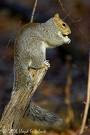
Gray squirrels are scientifically classified in the Order Rodentia along with porcupines, rats, mice, beavers, and other gnawing mammals. Their scientific name is Sciurus carolinensis although they are more commonly known as “cat squirrels” because of their agile movements and nervousness which resembles that of a cat. The gray squirrel is a medium-sized squirrel with dark yellowish rusty upper parts, especially on the head and back. The legs, arms, sides of neck, and sides of rump have gray-tipped or white-tipped hairs, giving these parts a gray appearance. Hairs of the tail are dull yellow at the base, then blackish, and tipped with white. The belly is white and ears have a conspicuous white spot at base in the winter. The gray squirrel averages 18 inches in total length with a tail averaging about 8 inches. Adults weigh between 11 and 21 ounces. Cat squirrels are highly gregarious and noisy. When the woods are otherwise quiet and still, these squirrels can be heard “cutting” acorns and constantly “barking”. The voice is described as being a c-h-u-c-k c-h-u-c-k c-h-u-c-k repeated rapidly and followed by a buzz and finished with a grunt. When one squirrel is alarmed, it will sound a warning “bark” as if to instruct the others to remain quiet until the danger has passed.
In Texas, gray squirrels’ native range is confined to the eastern 1/3 of the state. Within this range, they are confined to the river and creek bottoms. They make their homes in large, forested areas of mature hardwoods where the canopy is dense enough to permit them to leap from tree to tree through the crowns, without descending to the ground. Optimum habitat includes a mixture of mature hardwoods including oak, sweetgum, pecan, hickory, beech, and elm with an understory of mulberry, hornbeam, yaupon, huckleberry, and holly. As with most wildlife species, habitats with greater variety of trees, shrubs, and vines are home to a greater number of squirrels.
Although young gray squirrels may be found anytime of year, there are 2 main breeding periods – winter and summer. With a gestation period of 42-44 days, most young are born in February-March and August-September. Litter sizes vary from 1-4 young per litter. Young are born naked, blind, and deaf, without any teeth. They are completely dependent on their mother until they gradually grow teeth and hair and their eyes and ears are opened. At 14 weeks of age, they become independent of the mother. Gray squirrels prefer to raise their young in tree cavities 20-30 feet above the ground. During the summer or where tree cavities are limited, adults may bring forth young in leaf nests carefully constructed of twigs and leaves and lined with shredded bark, plant fibers, and grasses. There are usually 2 openings to these nests. Nests are used throughout the year as resting places and for refuge. They are strongly built to withstand wind and rain.
Gray squirrels spend tireless hours obtaining food both for now and later. Their primary food source is hard mast such as acorns, pecans, and hickory nuts so they must bury these items when available in the fall and uncover them throughout the year. Other food items included in their diet include: fruits of yaupon, hawthorn, blackberry, mulberry, and grape; maple and elm buds; moth and butterfly larvae; fungi; and grass seeds. To maintain proper body condition a gray squirrel must consumer 0.2lb of food per day. According to one calculation, it would take 7 water oaks and 15 red oaks to produce enough acorns to feed 2 squirrels for a year. This calculation does not take into account the competition these squirrels have with deer, fox squirrels, raccoons, opossum, woodpeckers, flickers, bluejays, flying squirrels, crows, rats, mice, and feral hogs for these same acorns. As a result, it is vitally important to the existence of gray squirrel populations that forests be managed to maintain an abundance of mature, mast producing oaks and pecans.
Land fragmentation, timber harvest, and competition with increasing populations of white-tailed deer and feral hogs in the river and creek bottoms of east Texas pose a real threat to gray squirrels. Many whom have childhood memories of hunting gray squirrels in the woods behind their parent’s or grandparent’s homes have given up the sport in pursuit of more productive endeavors because of reduced squirrel populations in recent years. Mature hardwoods have been cleared or thinned to make room for home sites, subdivisions, roads, or for profit from timber harvest. However, where dense stands of mature oaks and pecans remain in and along the river bottoms, gray squirrels thrive - especially after a good mast producing fall like we experienced in 2007. When clearing timber on your property, remember the cat squirrels and other creatures that rely on the acorns for food and the natural cavities for den sites. When sitting in the woods, hunting deer, hogs, or ducks, take a minute to recognize the barks of cat squirrels and their constant feeding activity accentuated by nervous movements and agile leaps from treetop to treetop.


.jpg)


